

National Council of Resistance: Iran After Khamenei... A Regime in Crisis and a Society on the Brink of Explosion... The Popular Will Will Determine the Country's Future

- Europe and Arabs
- Saturday , 14 March 2026 4:3 AM GMT
Paris – Tehran: Europe and the Arabs
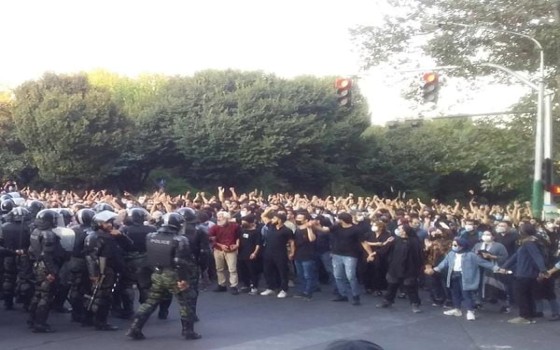
A statement distributed by the National Council of Resistance of Iran (NCRI), a copy of which we received, said: “The rapid developments in Iran since the death of Ali Khamenei and the appointment of his son Mojtaba as his successor indicate that the Velayat-e Faqih regime has entered its most dangerous phase since its establishment more than four decades ago. The unfolding situation inside the country demonstrates that the regime has not only failed to overcome its structural crisis but has also become more fragile and volatile, at a time when Iranian society is on the brink of another explosion.” The statement added that the press briefing held in Paris by Mohammad Mohaddessin, Chairman of the Foreign Affairs Committee of the NCRI, painted a clear picture of the depth of the crisis the regime is experiencing. Iranian society, as he described it, resembles “a fire under the ashes” or “a volcano about to erupt,” with cities living in a state of anxiety and anticipation amidst war, deteriorating economic conditions, soaring prices of basic goods, and the lack of even the most basic means of protection for civilians. Meanwhile, the regime appears to be in a state of genuine panic over the possibility of a new popular uprising. Therefore, it has resorted to a series of The simultaneous repressive measures, from deploying riot police in major squares and intersections, to arming the Basij militia and issuing orders to fire on protesters, to cutting off the internet and closing schools and universities to prevent public gatherings, clearly reflect that the regime's primary concern is no longer confronting external wars, but rather preventing an internal explosion that could topple it.
However, the most significant development in the Iranian political landscape is the clear shift towards establishing a hereditary system of power. The appointment of Mojtaba Khamenei as the new Supreme Leader was not presented as a natural transfer of power, but rather appeared to many as an attempt to salvage a crisis-ridden regime by reproducing a family-based dictatorship. Instead of bolstering stability, this move revealed deep cracks within the regime's structure itself, with evidence pointing to divisions within the Assembly of Experts and a decline in the regime's support base.
Nevertheless, the crisis in Iran is not solely a power struggle, but is also linked to the rising role of organized resistance within the country. Information presented by the Iranian opposition indicates the continued activity of resistance units and the expansion of operations against centers of repression and regime institutions. In several cities. Furthermore, the existence of a broad social network of supporters and families of prisoners and martyrs constitutes, according to the opposition, a growing social base supporting the path to change.
Amid these developments, a fundamental question arises regarding the future of Iran: Can change come through foreign intervention or through international appeasement policies? The answer that the Iranian opposition has been reiterating for years is that the true solution lies in the will of the Iranian people themselves, and in their ability to overthrow the regime through an organized uprising leading to the establishment of a democratic system.
Thus, Iran today appears to be at a crucial historical crossroads. The regime, which has long tried to survive through repression and exporting crises, faces an increasingly angry and organized society, while the gap between the authorities and the people widens. In such historical moments, a small spark is often enough to ignite major transformations.
What is happening in Iran today is not merely a passing political crisis, but a struggle for the future of an entire country. While the regime attempts to impose stability by force, demands for freedom and popular sovereignty are escalating. Therefore, the next stage may be decisive in determining whether Iran will remain captive to a crisis-ridden regime, or whether it will enter a new phase of political transformation.



No Comments Found