

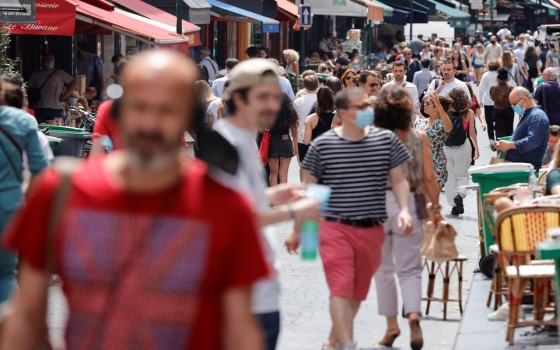
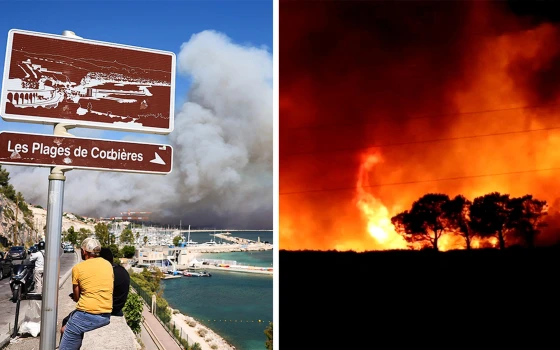
Europe continues to suffer from extreme heat, particularly in France, Spain, Portugal, and Belgium. High death tolls, forest fires, and a scramble to buy fans and air conditioners.

- Europe and Arabs
- Friday , 3 July 2026 9:40 AM GMT
Brussels: Europe and the Arabs
The suffering continues in European countries due to the extreme heat, although some countries, like Belgium, have seen a relative improvement in the last two days. Local media reported that after the heatwave that struck the country last week, the weather in Flanders remains pleasant (until further notice). Elsewhere in Europe and the world, however, the weather remains hot and humid.
Belgian Socialist Party Leader: "The Government Abandoned Citizens to Their Fate" During the Heatwave
The government announced yesterday a state of alert, effective from 12:00 AM today until 11:59 PM on Monday, due to a "significant increase in the risk of rural wildfires." The IPMA (International Fire Protection Association) indicates that the restrictions outlined in the government's warning take precedence over those specified in the rural wildfire risk levels. According to Euronews, the Brussels-based European news network, the alert includes:
Among the exceptional measures are a ban on accessing, moving within, or remaining in forested areas, as well as a ban on the use of fireworks or other explosive materials and devices. Burning in fields and certain activities within forested and rural areas are also prohibited. The warning also entails strengthening the monitoring system and raising the level of preparedness of the authorities, particularly the GNR (National Forestry Regulatory Authority) and PSP (Popular Fire Service).
The country is experiencing a severe heatwave, with temperatures exceeding 40 degrees Celsius in some areas. Nights are also expected to be very hot, with low temperatures exceeding 20 degrees Celsius and low humidity levels. IPMA has placed 12 mainland regions under a red alert, the highest level, due to the heatwave. The regions of Braganza, Castillo Branco, Faro, Guarda, Vila Real, and Vézebo are under an orange alert.
Temperatures in Spain to reach 40°C: "High fire risk"
Starting Sunday, Spain will face another severe heatwave. Temperatures could rise sharply, especially inland, sometimes reaching 40°C. This is the forecast from the Spanish Meteorological Agency (Aemets). The heatwave is expected to last until at least Wednesday. During this period, according to the agency, there is also a "high fire risk" in areas bordering Portugal. Severe thunderstorms may follow, potentially causing disruptions.
Spain has been experiencing a severe heatwave for weeks. June was the second hottest June on record in the country. An estimated 1,000 additional heat-related deaths are expected in the country.
According to the leader of the Socialist Party, Paul Magnette, the government "abandoned" the population during the heatwave that struck the country last month. Speaking on Channel X, he said, "The crisis claimed hundreds of lives, but it did not overcome the inaction of the ministers." Magnette's statement comes in response to the excess death figures during the recent heatwave, announced by the Risk Management Group on Thursday evening. The total number of excess deaths reached 1,222 between June 18 and 29.
Magnette added, "An excess mortality rate of 39%, and the federal government took no action." The climate and public health crisis has claimed hundreds of lives, but it hasn't overcome the inaction of ministers. Citizens have been left to their fate, authorities have failed to organize themselves, and there seems to be no hope of improvement in the future. Yet, more heat waves are expected.
1,222 excess deaths in Belgium due to the heat wave: "Unprecedented"
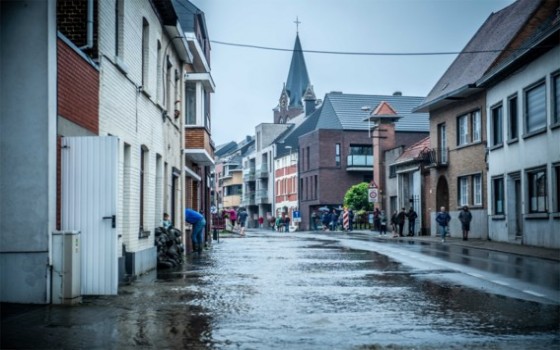
As a result of the heat wave in Belgium, high excess mortality rates have been recorded across the country, according to the risk management team. Preliminary data shows that Belgium recorded a 39% increase in deaths (1,222 excess deaths) between Thursday, June 18, and Monday, June 29. Of these deaths, 530 were among people aged 85 and over. There was also a significant increase in deaths among those under 65 (180 people). This represents the highest daily death toll in our country since the first wave of the coronavirus. By June 29, there had been seven days with a statistically significant increase in the mortality rate. Deaths peaked on Saturday, June 27, with 572 fatalities recorded. This significant increase in the death rate during the heatwave is unprecedented in our country. The heatwave was exceptional, with temperatures exceeding 30 degrees Celsius for seven consecutive days. Nights, in particular, were alarmingly hot.
However, these figures are still preliminary, according to a report by ScienceSano.
France
Public Health France announced a 29.1 percent increase in the number of deaths in the country during the week of June 22-28, as France grappled with a severe heatwave.
The agency explained that this equates to 2,025 additional deaths compared to the previous week.
The largest increase in deaths was recorded in the Île-de-France region, where it rose by 62.8 percent, while a similar increase was reported in the Pays de la Loire region of western France.
The country experienced a sharp rise in temperatures last week, exceeding 40 degrees Celsius in many areas, further straining emergency services and hospitals.
Although officials described the current heatwave as more severe than the deadly one of 2003, they expect its overall health impact to be less severe.
Nicolas Revel, director general of the Paris public hospital system, said he expects the final death toll from the June heatwave to be lower than the 2003 figure of approximately 15,000 deaths, but "most likely" higher than last year's heatwave, which claimed around 5,700 lives.
Opposition politicians criticized the government's handling of the extreme weather.
On Thursday, the Green Party submitted a motion of no confidence against Prime Minister Sébastien Lecornu's government, arguing that it had failed to adequately prepare the country for the heatwave. Hundreds of shoppers also lined up outside Lidl stores across France on Thursday after the supermarket chain announced it would be distributing 200,000 portable fans and air conditioners, leading to long queues, arguments, and police intervention at several branches.
Portugal: More than 1,000 personnel battling forest fires on the ground
The intense heat shows no signs of abating, and neither do the first major fires of the season. Around 9:30 a.m., four large fires were mobilizing more than 1,500 personnel in the field to fight the blazes.
The most worrying fire is the one in the municipality of Fuzela, in the Viseu region, which started at dawn on Thursday. The fire has three active fronts and continues to spread. According to data published on the Civil Protection website, around 9:30 a.m., 938 personnel were battling the fire, supported by 288 ground vehicles and eight aerial vehicles.
The National Civil Protection Authority confirmed to the Lusa news agency that the fire is threatening residential homes and has already halted train traffic on the Fuga line between Moresca do Fuga and Agueda. A fire truck and several agricultural implements were also destroyed. At least seven people were injured, according to the ANPC (National Agency for Civil Protection).
In addition to the Fuzela fire, fires are also burning in the municipality of Barcelos, where more than 120 personnel and two aircraft are involved in fighting them, as well as in the areas of Sinveix and Castelo de Paiva.
Portugal in the red zone: The mainland under maximum fire risk
Almost all of Portugal is under a maximum and very high risk warning for wildfires in rural areas, according to the Portuguese Institute for the Sea and Atmosphere (IPMA). Only six coastal regions have a moderate risk level.




No Comments Found