

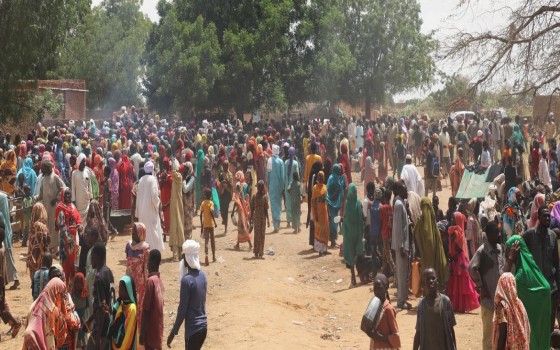
Sudan: In response to a request from European countries, the Human Rights Council discussed the crisis in El Obeid amid UN warnings of a repeat of the El Fasher and Zamzam atrocities. The number of newly displaced people has increased by 65% since the escalation began in October.

- Europe and Arabs
- Saturday , 4 July 2026 12:40 PM GMT
Khartoum – Geneva: Europe and the Arabs
The UN High Commissioner for Human Rights, Volker Türk, stated that another human rights catastrophe is unfolding in El Obeid, the capital of North Kordofan State in Sudan. He stressed that the international community cannot allow a repeat of the widespread atrocities that occurred in the Zamzam camp for internally displaced persons and in El Fasher, North Darfur, last year.
Türk noted that civilians have endured siege-like conditions for 18 months and have been subjected to continuous drone strikes amidst the ongoing conflict between the Sudanese Armed Forces and the Rapid Support Forces for control of the areas surrounding the city.
This came during his address to the urgent debate held by the Human Rights Council on the human rights situation in and around El Obeid in the context of the ongoing conflict in Sudan. The debate took place during the Council's 62nd session in Geneva.
This urgent session was convened in response to a formal request submitted by a group of countries including Germany, Ireland, the Netherlands, Norway, and the United Kingdom. According to the UN Daily News Bulletin,
The group stated in its request that "this action has become necessary due to the risk of a potential escalation on the ground, where some 500,000 civilians are at risk of widespread violations amounting to mass atrocities. The increase in drone attacks has also led to the destruction of civilian infrastructure, causing severe shortages of fuel and water and civilian casualties, under siege-like conditions that have trapped thousands of people inside El Obeid and cut off them from basic services."
Drone Attacks Claim Lives
The High Commissioner reported that his office had documented 15 drone attacks on El Obeid and surrounding areas between June 6 and 28, resulting in the deaths of at least 45 civilians and injuries to 41 others, warning that the actual number of civilian casualties is likely higher.
He added that throughout the Kordofan region, drones launched by both sides have repeatedly targeted markets, schools, fuel stations, water infrastructure, and civilian vehicles. Turk said: “These attacks, coupled with fuel shortages, have a compounding effect, hindering civilians’ access to clean water, food, transportation, and healthcare, as well as disrupting their communication with each other and the outside world.”
The UN official said his office had documented “patterns of summary executions, abductions, torture and ill-treatment, sexual violence, and looting along the routes taken by displaced people across the Kordofan region.”
He added that those remaining in El Obeid face the risk of arbitrary arrest and detention, noting that people who have fled areas controlled by the Rapid Support Forces and their allies are often accused of collaborating with the other side.
He stressed that what is happening is a “red alert” that should reach the offices of heads of state and government around the world.
Turk said: “All leaders must use their influence to pressure all parties, particularly the Rapid Support Forces, to halt the attack on El Obeid, end attacks targeting civilians and vital infrastructure, stop the flow of weapons, and comply with their obligations under international law.” He also called for accountability for the crimes committed and for ensuring the safe and voluntary evacuation of civilians from El Obeid.
Turk further stressed the need to "pay much greater attention to the political economy of this war. The leaders of the warring parties bear the greatest responsibility for three years of horrific suffering, but behind them are actors—both internal and external—who profit from this bloody violence."
He also called for an end to the continued flow of weapons from outside the country to all sides, warning that "without action to end this situation, the conflict risks continuing indefinitely."
Fear grips the residents of El Obeid.
Mona Rishmawi, a member of the Independent International Fact-Finding Mission on Sudan, said in her oral update to the urgent debate: "It is disheartening that we are meeting again to discuss the situation in yet another city in Sudan." She added: “Despite the difficulty of communication, we spoke with residents of the city. Fear is widespread; fear for their fate and the fate of their city. This fear has been exacerbated by statements and videos circulating on social media accounts affiliated with the Rapid Support Forces (RSF), showing military buildups around El Obeid and preparations to enter the city.”
She stressed that the RSF must immediately cease attacks targeting civilians and civilian infrastructure, including fuel depots, water facilities, transportation routes, hospitals, markets, schools, and residential areas.
She also stated that the Sudanese Armed Forces and their allies must avoid positioning military personnel and equipment in or near civilian areas and cease intimidating civilians.
Consequences of Impunity
For his part, the Chair of the Special Procedures Coordination Committee, George Katrougalos, expressed the Committee’s concern about the rapidly deteriorating situation in El Obeid.
He warned that the continued failure to end the conflict in Sudan, coupled with the worsening humanitarian catastrophe, “deepens the crisis facing the multilateral system and undermines the credibility of the collective security architecture established by the UN Charter.” Katrougalos said, “One of the most alarming aspects of this conflict is not just the scale of the violations, but also their frequency.”
He added that documented patterns over the past three years show that many of these abuses are no longer isolated incidents, but have become recurring features of how hostilities are conducted. This recurrence underscores the devastating consequences of continued impunity.
He stressed the need for accountability to achieve justice for victims, adding, “Peace cannot be sustained while serious violations go unaddressed and victims are denied truth, justice, and reparations.”
Rapidly Deteriorating Humanitarian Situation
The International Organization for Migration (IOM) has expressed grave concern over the rapidly deteriorating humanitarian situation in Sudan’s Kordofan region, where escalating violence has led to a sharp increase in displacement.
The IOM stated that the number of newly displaced people has risen by 65% since the escalation began in October 2015, increasing from over 132,000 in February 2016 to more than 219,000 by the end of June, highlighting the accelerating impact of the conflict on civilians.
The organization has recorded more than 100 displacement incidents in less than nine months, averaging one major incident every two to three days.
Speaking from Port Sudan to journalists in Geneva on Friday, Mohamed Rifaat, IOM Chief of Mission in Sudan, said, “Civilians continue to be the primary targets in this conflict.” Rifaat explained that the goal of this strategy "is primarily to displace them, and then to begin seizing cities and emptying them of their inhabitants."
He added that what happened in El Fasher was not an isolated incident, noting that it is part of a long-term trend in Sudan that the international community has failed to stop.
Regarding the situation in El Obeid, Rifaat stressed the urgent need to deliver aid to the residents, saying, "We cannot reach them. We hear stories from our data collectors, who are assessing needs, that these residents lack water and electricity and want to leave, but they cannot."


No Comments Found