

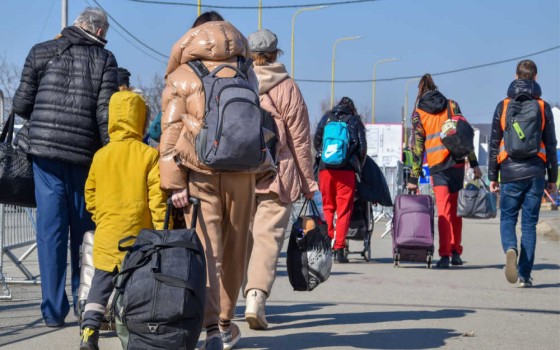
Global Survey Shows Continued Public Support for Refugees Despite Economic and Social Pressures in Host Countries… Divergent Views on Border Closures and the Right to International Protection

- Europe and Arabs
- Wednesday , 15 July 2026 3:56 AM GMT
New York: Europe and the Arabs
Public support for refugees remains largely intact, despite years of political turmoil and socioeconomic pressures in host countries, along with the controversy and polarization surrounding migration issues and policies.
This is according to a new global survey conducted by Ipsos in partnership with the UN Refugee Agency (UNHCR), covering 29 countries. As reported in the UN Daily News, the survey showed that 66 percent of respondents agree that people fleeing war or persecution should be given the opportunity to seek asylum in another country. This represents a decrease of just one percentage point compared to 2025, a level that remains largely consistent with pre-COVID-19 pandemic levels.
The findings suggest that these attitudes do not reflect opposition to refugee protection. Rather, they demonstrate that many support providing safe haven to those forced to flee, while concerns persist regarding asylum systems, border management, and the integration of refugees into host communities. The survey revealed that there is no single global view of refugees; rather, attitudes vary depending on local realities, media coverage, political debates, and national experiences.
Which two countries topped the list of those most supportive of refugees?
The highest level of support was recorded in Sweden and the Netherlands, where 78 percent of respondents agreed with the right of those fleeing war or persecution to seek asylum, followed by Spain at 76 percent. Australia, Brazil, and the United States also recorded the most positive attitudes toward the contributions of refugees to their societies.
Some countries have seen significant changes over time. Support in Japan rose to 64 percent, compared to 23 percent in 2019, while in France it increased to 68 percent from 43 percent during the same period.
Trinh Tu, Managing Director of Ipsos UK, said: “People still support protecting those forced to flee, and that hasn’t changed much. But many are questioning how refugee protection is implemented in practice and whether the existing systems are fair.” An encouraging sign
The survey revealed that 61 percent of respondents believe many seeking international protection are motivated by economic opportunities or social services, rather than having legitimate grounds for asylum. Forty-nine percent believe borders should be closed to refugees, while 44 percent believe refugees will be able to successfully integrate into host communities.
Dominique Hyde, Director of External Relations at UNHCR, said: “At a time when conflict, violence, and persecution continue to force millions of people to flee their homes, and despite the politicization and exploitation of the refugee issue, the continued support for refugee protection is an encouraging sign.”
She added that the public generally still supports the principles established by the Refugee Convention 75 years ago and desires a protection system that is fair, efficient, and based on shared responsibility. She emphasized that UNHCR is working with governments to ensure that asylum systems are fair and effective.
Younger generations’ attitudes towards refugees
The survey also indicated that younger generations expressed more positive attitudes towards refugees compared to older generations. Forty-nine percent of Generation Z (born between 1997 and 2012) believed that refugees would successfully integrate into society, compared to only 39 percent of Baby Boomers (born between 1946 and 1964).
Young people were also less likely to support border closures or question the motives of refugees, although concerns about integration, border management, and the credibility of asylum claims persisted to varying degrees across different age groups.
Sharing the Responsibility for Supporting Refugees
With declining humanitarian funding, the survey showed that public opinion increasingly expects the responsibility for supporting refugees to be shared among governments, international institutions, NGOs, and other actors. Compared to 2025, the percentage of those who believe NGOs should play a larger role rose to 28 percent from 23 percent, and the percentage who hold their governments more responsible increased to 20 percent from 16 percent. Meanwhile, the percentage who believe the primary responsibility lies with wealthier countries decreased to 21 percent from 30 percent.
When asked how to respond to different displacement crises, most participants favored direct emergency humanitarian aid, along with diplomatic action and the provision of temporary protection.
The findings suggest that many view refugee protection as a broader framework than just resettlement, while emphasizing that resettlement remains one of the most important protection pathways for the most vulnerable refugees.



No Comments Found